Burnout Recovery and Nervous System Reset: How Meditation Actually Helps

Sheenam Midha
Writer
May 20, 2026 · Updated May 20, 2026
If you've been low on energy for weeks and feel wired when you get to bed at night let me tell you, it’s not laziness or weakness. This is the natural reaction of your nervous system to survival mode. And a week off likely won't help.
Recovery from burnout and resetting the nervous system go together. It's not about doing less to make recovery happen. It's about providing your body with a natural route to relaxation. This is where meditation for burnout steps in: it isn't a feel-good fad; it's one of the only few things that has proven to have some research.
What's really going on in your body, and how to fix it.
What Burnout Does to Your Body
The nervous system has two principal parts. The sympathetic nervous system responds to stress and danger, and does this by accelerating things. The parasympathetic nervous system has to do with recovery and rest, it slows down.
Burnout is like being stuck in 1st gear. Cortisol stays elevated. The heart rate is elevated. The prefrontal cortex of the brain is damaged (regulating focus and emotions). This is why you don't feel tired after you have undergone a burnout. It makes you sleepy and irritable, and you can't even enjoy things you love anymore.
Nervous system regulation is an intentional effort to move from that alarm state back into a rest state. One of the most researched methods of doing just that is through meditation for burnout.
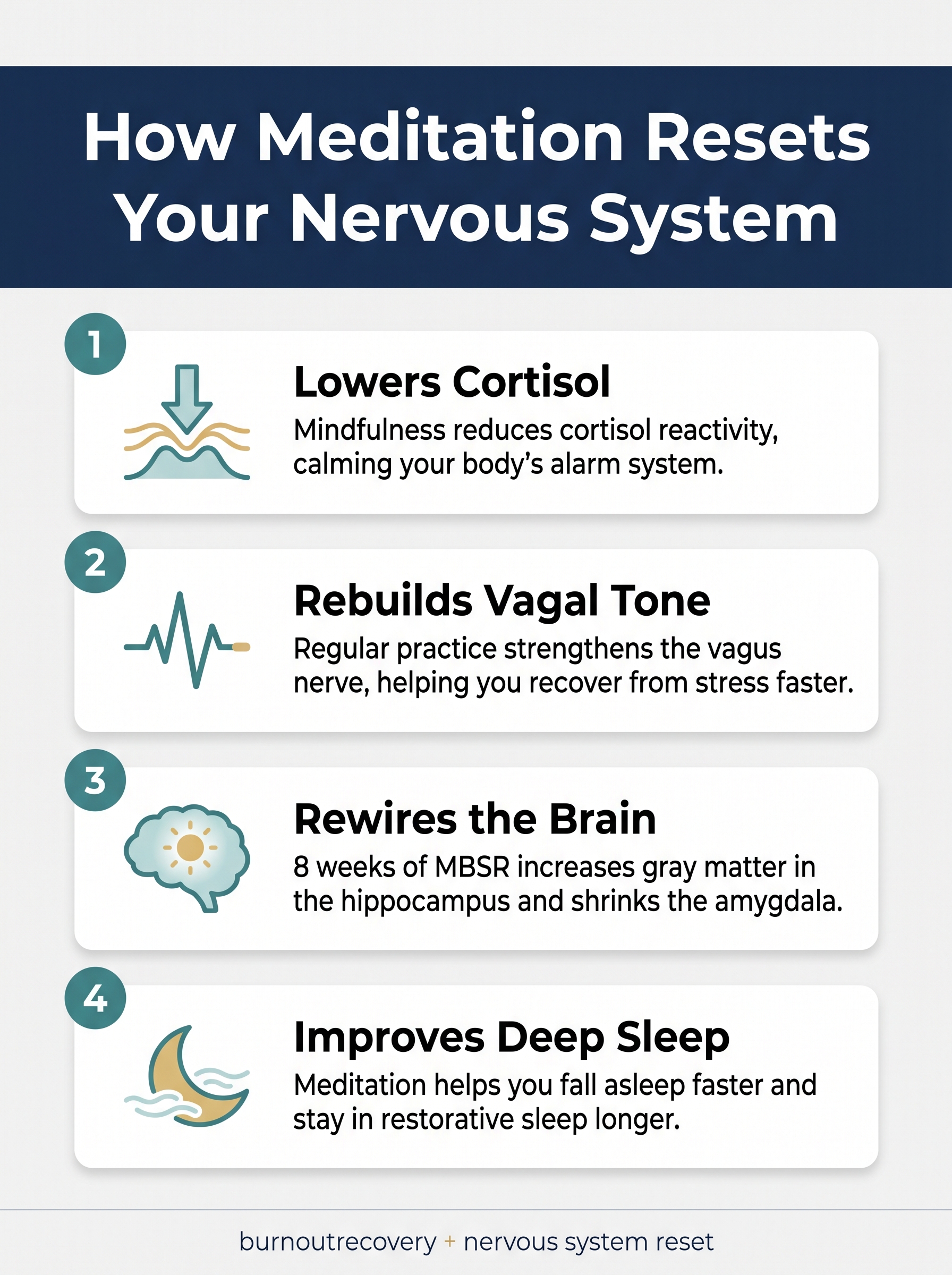
How Meditation Helps With Burnout Recovery
It Directly Activates the Parasympathetic Nervous System
This is the basic action. When you breathe slowly and deliberately and focus your attention, your brain knows that you're safe. This signal stimulates the rest-and-digest elements of your nervous system (parasympathics). Heart rate drops. Cortisol decreases. Muscle tension softens.
In a 2014 research study at Carnegie Mellon University, it was discovered that the training in mindfulness meditation led to cortisol reactivity reduction in the stressed participants. The results showed that the practice of mindfulness could offer benefits to the regulation of hormones, which may not happen during the time of casual sleep.
Because if it were not for this, how meditation can help in the process of recovery from burnout would be only a wellness conversation. Biology is precise and quantifiable.
It Rebuilds Vagal Tone
The vagus nerve extends from your brainstem through your chest and abdomen. The primary road of your parasympathetic nervous system. The function of this nerve is called "vagal tone" and directly influences the ability of your body to move from stress back to calm.
Over time, burnout leads to reduced vagal tone. It is rebuilt through meditation on a regular basis.
In a study published in 2010, Barbara Fredrickson and her colleagues at the University of North Carolina determined that, over time, loving-kindness meditation was shown to increase the vagal tone of participants, including those who were not particularly experienced in meditation.
It Actually Changes Your Brain
In a 2011 study, published in the well-known Harvard Medical School journal, researchers at Massachusetts General Hospital discovered that eight weeks of a program called mindfulness-based stress reduction (MBSR) altered the physical structure of participants' brains. The hippocampus, which is involved with memory and learning, and the amygdala, the brain's alarm center, showed increases and decreases, respectively, in gray matter density.
This is important to anyone who is experiencing emotional burnout recovery. These same brain regions are slowly degraded via the process of burnout. Burnout can be overcome with the help of meditation.
It Fixes the Sleep Problem
Almost always, burnout is accompanied by poor sleep. One study in 2015 in the Journal of Internal Medicine revealed that mindfulness meditation can assist individuals with sleep issues to fall asleep quicker and stay asleep longer than a sleep hygiene education group.
When the nervous system is most regulated, it does its deepest repair work, sleep. Great sleep equates real recovery time, not just rest time, for your parasympathetic system.
How to Calm Your Nervous System When Burned Out: 4 Meditation Practices That Work
When you're feeling burnt out, it can be hard to get your nervous system to relax. Here are four meditation practices to help you turn off your nervous system.
When burnt out, knowing how to relax your nervous system is not just any relaxation technique. Some strategies seem like more work when you're in the middle of a burnout. The low-effort ones below are intentional.
Body Scan Meditation
Slowly take your attention to various areas of your body, draw awareness to them, but do not try to change them. This is passive; it is not something that you concentrate on. It's very effective since it demands nothing of the already depleted system. It is a good general rule to start 10-15 minutes before going to sleep.
Box Breathing (4-4-4-4)
Inhale for 4 counts. Hold for 4. Exhale for 4. Hold for 4. Repeat 4–6 times. This directly stimulates the vagus nerve through the diaphragm and can slow down the heart rate in just minutes. The best one to use for resetting during the day when lying down isn't an option.
Loving-Kindness Meditation
Spending quiet time thinking positive thoughts about oneself and others. This is a gentle one but one of the best researches for mindfulness for stress and burnout, especially for those in caring professions who suffer from compassion fatigue as well as burnout.
Breath Awareness (Unguided)
Simply observing your breathing. No App, No Guide, No Goal. Not as easy as it sounds. But after you have ceased expecting to feel calm during the session, that's when it really begins to become effective. The regulation is not an end to thinking but a beginning below it.
15–20 minutes of daily activity is a good starting point. Consistency is more important than length of time. The recovery from burnout and reset of the nervous system is not a one-session process; it is a gradual process that is developed through repeated practice.
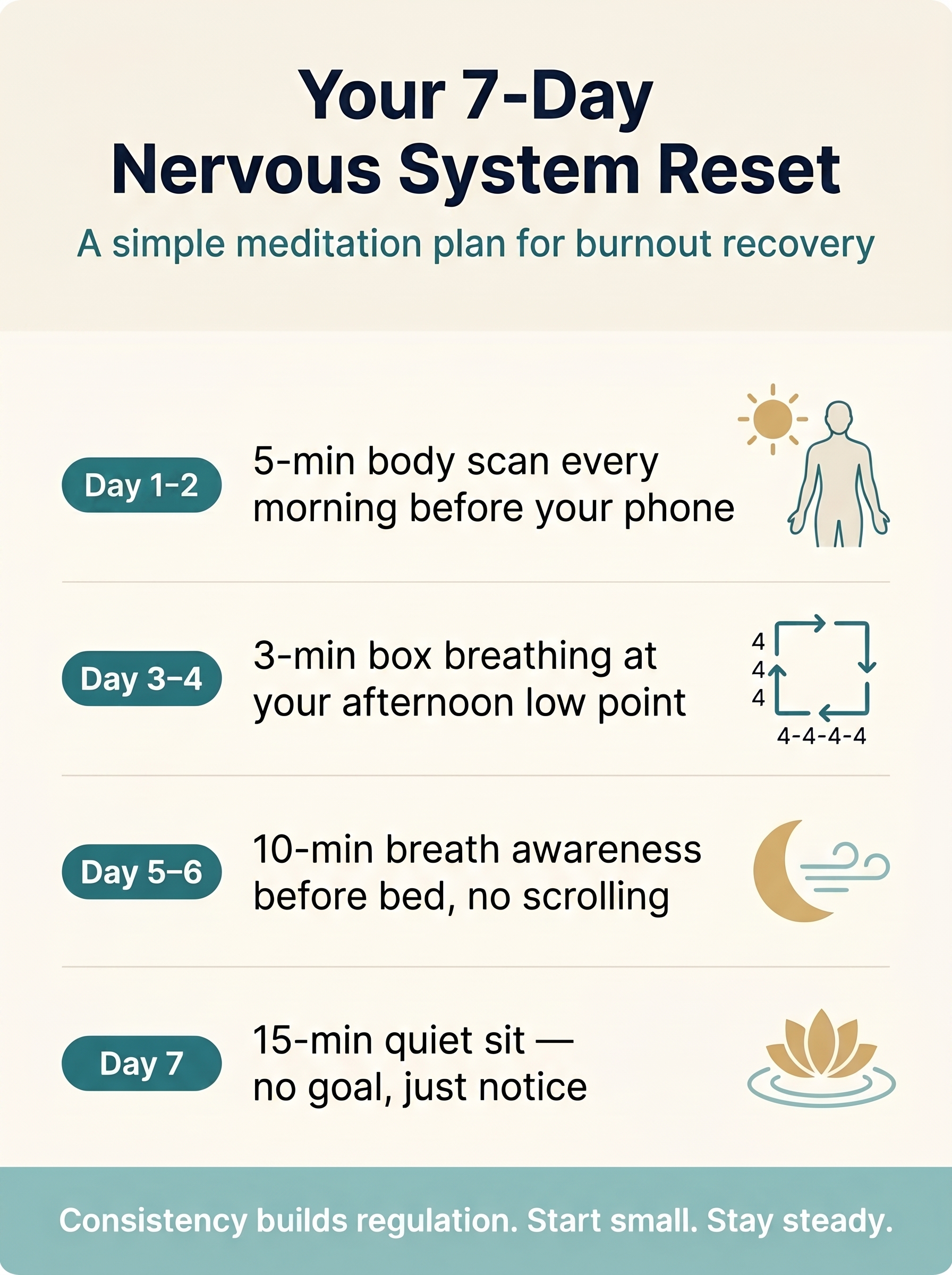
The Best Meditation for Nervous System Reset: A 7-Day Starter Plan
When you're feeling like you're 'burnt out' and in need of the best meditation for a reset, structure will help. Sounds like a straightforward week:
Days 1–2: Morning 5-minute body scan before using the phone.
Days 3–4: Do box breathing on days 3–4 during the time of your day when you usually feel the most tired.
Days 5–6: 10 minutes of breath awareness before going to sleep, as opposed to scrolling through social media.
Day 7: The purpose of this is to note, observe, and be silent. The intention is to notice, observe, and be silent.
No app required. No special setup. The idea is to begin to signal to the nervous system that it's OK to rest.
Emotional Burnout Recovery Meditation Techniques That
1. Help Beyond the Session
The best way to use emotional burnout recovery meditation techniques is when they continue outside of your meditation time. Some of the reasons that will make that more possible:
2. Practice at the Same Time Each Day
The nervous system becomes conditioned to the change when it is consistent. As time goes on, the body begins to reduce its response to stress just before you even start.
3. Don't Aim for Silence
During meditation, don't despair if your mind is busy; it's not a poor performance. It's what a burnt-out mind does! The practice is not suppressing the thoughts but becoming aware of them.
4. Track Sleep, Not Calm
Most people are unable to measure the changes in their nervous system regulation from day-to-day. It's easier and more reliable to tell if the quality of sleep is improving as a measure.
5. Pair It With One Low-Stimulation Habit
No screens for 20 minutes after meditating. Any amount of sensory input losses after the practice will stretch the parasympathetic window.
Meditation offers solutions to some of the underlying physiology of burnout, the regulation of cortisol, the recovery of the prefrontal cortex, sleep quality, and vagal tone. The research is specific; measurable changes to the brain structure can be seen as early as after 8 weeks. This is not something that's going to cure all of your ills for six months; however, this won't fix six months of overwork in a week. Do not use it as a single strategy for burnout recovery and nervous system reset; it is best used in conjunction with other strategies.
On a daily basis, the majority of people experience lower levels of tension in their bodies and slightly improved quality of sleep after 14 days of regular practice. Changes in emotion regulation and the cortisol response are more apparent in research after 4–8 weeks. Meditation techniques that will help recover from emotional burnout that are practiced daily tend to produce faster results than meditation techniques that are longer but practiced less frequently.
Box breathing is likely to be your starting point. It is brief (3–5 minutes), does not involve stillness, and directly impacts the vagus nerve. Lying-down body scans also work great. If sitting meditation seems like yet another chore to do, do less, don't give it up. The most effective meditation for a nervous system reset is the one that you will do regularly!
Relaxation (watching TV or taking a bath, etc.) decreases stimulation on a regular basis. Mindfulness for stress/burnout does something different: it trains the nervous system to self-regulate. With time, this helps to develop vagal tone, the capacity to move from stress to relaxation faster and more reliably, even outside of meditation practice.
Yes. Burnout can be caused by a variety of factors such as caregiving, sadness, chronic illness, stress in relationships, or any high-demand/low-recovery period in general. The nervous system is unable to tell the difference between work stress and personal stress. The techniques of meditation for burnout recovery are applicable to any burnout, even if it is not occupational.
Begin with 1 breath. If 5 minutes seems like too long, take a deep breath out. Then maybe two. To activate the parasympathetic nervous system, it doesn't need to be a formal session. Slow breathing out produces a response in the vagus nerve, even if the person is standing in a kitchen! Begin there, and gradually increase as capacity increases. The first step in calming your nervous system when burned out is to meet yourself where you're at!
Related Sessions
7 Signs You’re Actually Meditating Correctly
· Focus
Walking Meditation: A Guide for People Who Can't Sit Still
· Focus
Mindfulness vs. Transcendental Meditation: Finding Your Perfect Practice
· Focus
How to Meditate at Work Without Anyone Noticing
· Focus
The Connection Between Meditation And Heart Health
· Sleep
Burned Out, Exhausted, and Can’t Sleep? Here’s What Meditation Actually Does to That Cycle
· Focus
Guided Vs Silent Meditation: Which One Actually Works For You?
· Focus
Morning vs. Night: When is the Best Time to Meditate?
· Sleep
How To Manage High-Functioning Anxiety With Meditation
· Anxiety
5 Common Meditation Myths That Hold You Back
· Anxiety
The Science of Breathing: How Pranayama Changes the Brain
· Anxiety
10 Mindfulness Exercises for Busy Professionals
· Sleep
Related
7 Signs You’re Actually Meditating Correctly
Walking Meditation: A Guide for People Who Can't Sit Still
Mindfulness vs. Transcendental Meditation: Finding Your Perfect Practice
How to Meditate at Work Without Anyone Noticing
The Connection Between Meditation And Heart Health
Burned Out, Exhausted, and Can’t Sleep? Here’s What Meditation Actually Does to That Cycle
Guided Vs Silent Meditation: Which One Actually Works For You?
Morning vs. Night: When is the Best Time to Meditate?
How To Manage High-Functioning Anxiety With Meditation
5 Common Meditation Myths That Hold You Back
The Science of Breathing: How Pranayama Changes the Brain
10 Mindfulness Exercises for Busy Professionals