Walking Meditation: A Guide for People Who Can't Sit Still

Sheenam Midha
Writer
April 28, 2026 · Updated April 28, 2026
You've probably heard it a hundred times: "Just meditate. It'll help."
So you took a seat, closed your eyes, and inhaled. And then your mind started playing out your embarrassing work party moment from 3 years ago.
If you find it hard to sit still, there's nothing wrong with you. You're simply someone who needs to approach it from a different angle - and walking meditation might just be what you need.
Walking meditation techniques work precisely because they give your restless body something to do while your mind learns to slow down. Movement isn't a distraction from mindfulness. For many people, it's the only way in.
What Is Walking Meditation?
Walking meditation is a mindfulness meditation that you do while walking. Instead of focusing on your breathing as you sit, you focus on walking - the feel of your feet on the ground, the movements and sounds and smells and sights.
It originates from Buddhist practice, mainly Theravada and Zen, but you don't have to be religious to practice it. The mechanics are simple. There's good science underpinning it.
Why Movement Actually Helps Your Brain Calm Down
First, it's important to understand this.
If you're jittery, hyper, or depressed, sitting still can exaggerate your anxiety. You have energy in your body. And you're asking it to be still, like shaking a still soda bottle.
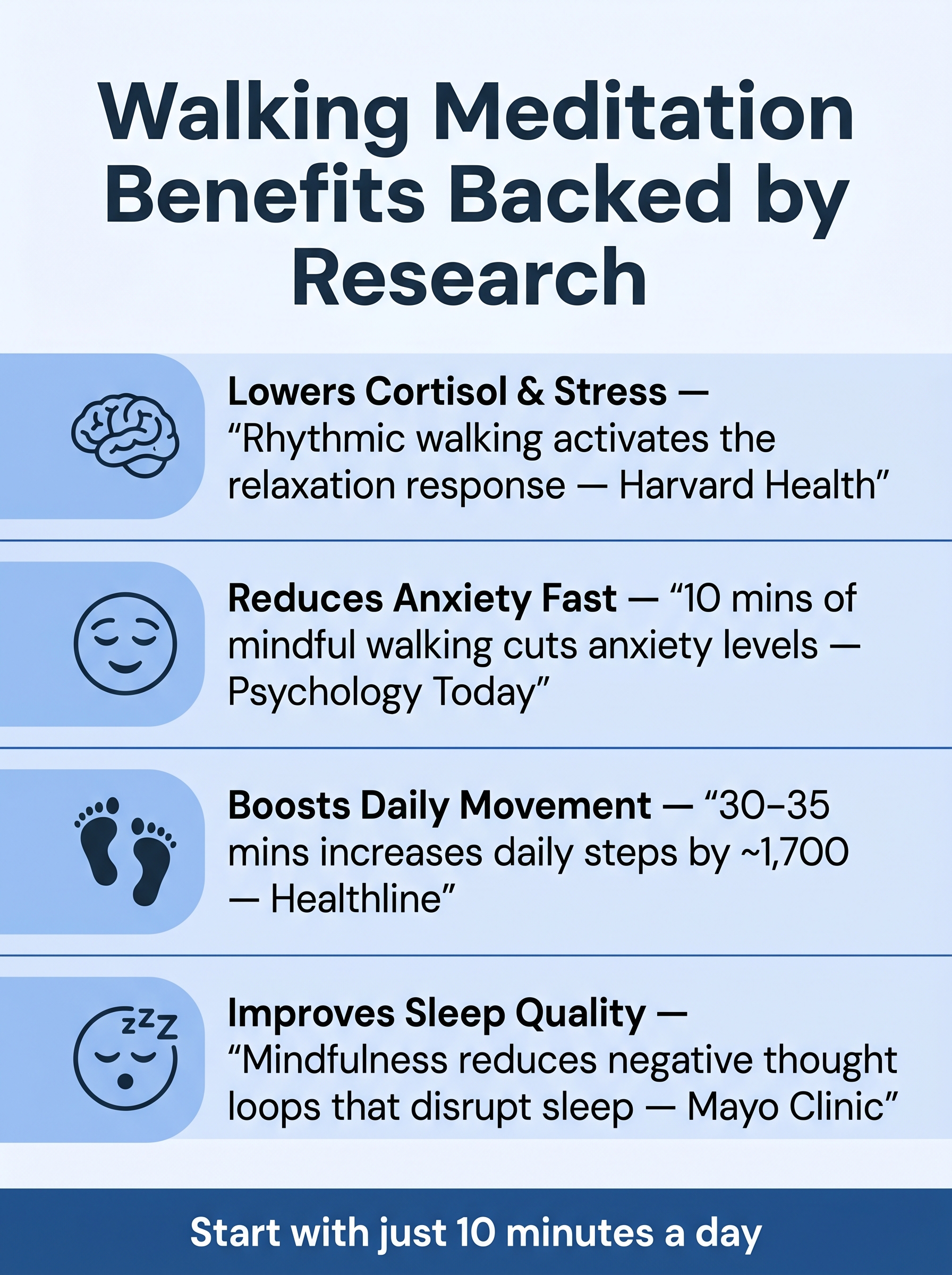
Exercise helps expend energy. Harvard Health states that repetitive activities, such as walking, trigger the relaxation response and decrease levels of the stress hormone, cortisol. But when you focus on mindfulness while walking, you're also in the present moment, which stops worrying or "monkey mind."
And there's good research on what this can do for your brain. A randomized controlled trial published by Psychology Today found that just 10 minutes of meditation (including walking meditation) greatly decreased anxiety levels in college students according to the State Trait Anxiety Inventory. The effect was not seen when students walked for 10 minutes. The key factor was mindfulness.
Healthline also goes on to report that 30-35 minutes of meditative walking has been proven to increase the number of steps we take each day (which is important because mental health and lack of physical health often go hand in hand). All in one go is really economical.
Walking Meditation Techniques: How to Actually Do It
There's no one way. Here are some, ranging from simple to complex.
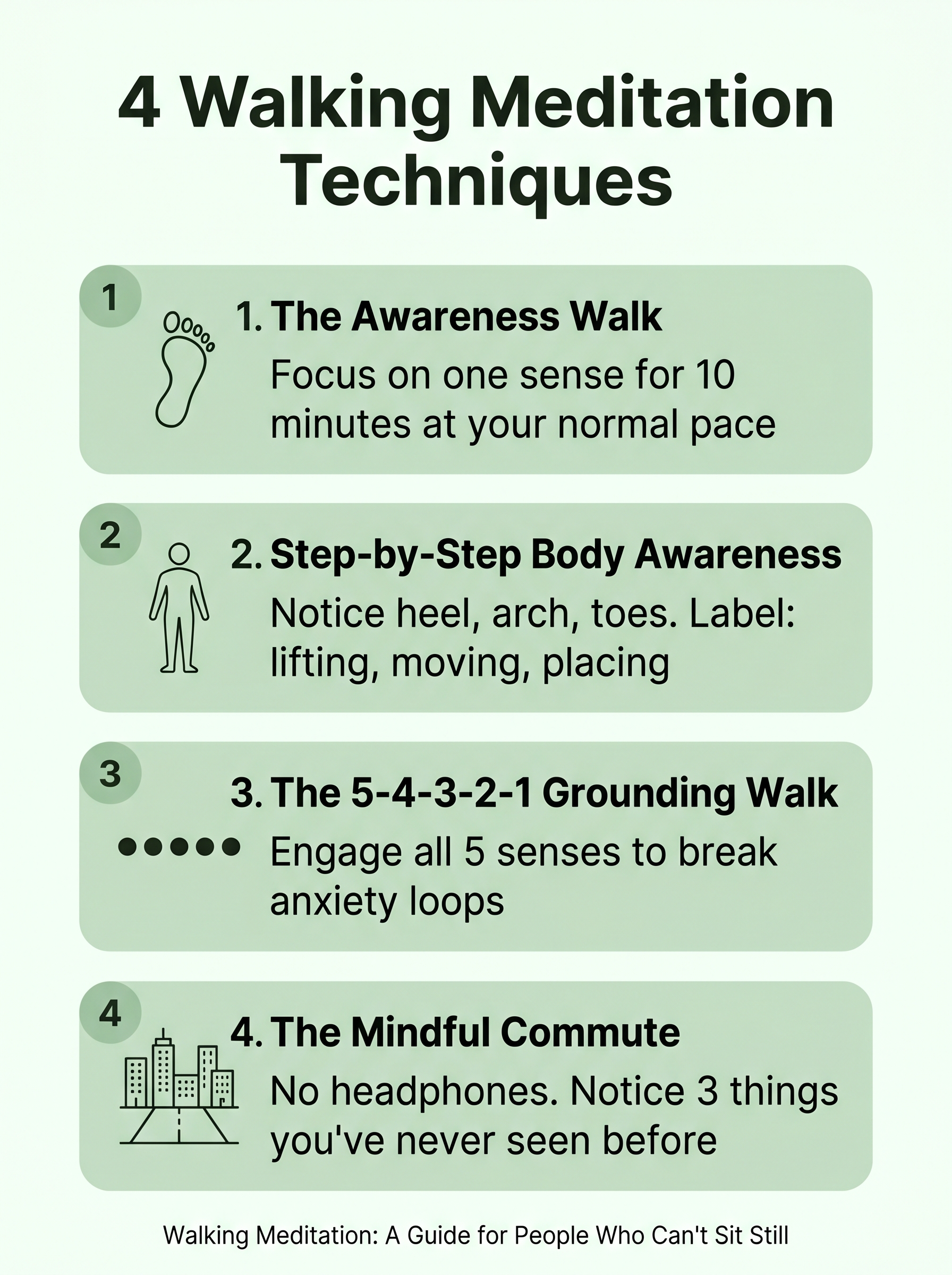
1. The Awareness Walk (Best for Beginners)
This is a great way to begin meditating while walking.
Walk at a comfortable pace - don't walk too slowly
Choose which sense you want to use: sight, sound, or touch
If you lose focus (you will), refocus on that sense
Do this for 10 minutes
That's it. No app required. No special location needed.
2. The Step-by-Step Technique
Here's a more traditional walking meditation. It involves slower movement.
Walk slowly, so you feel your steps
Consciously think: lift, move, put down
Sense the weight shift from heel, to arch, to toes
Breathe in step with the rhythm, if you want to - exhale as you put your foot down, inhale as you lift
This is a good technique if you're feeling wound up. Your body needs to slow down to accommodate the slower pace.
3. The 5-4-3-2-1 Walking Grounding Method
This is particularly good for anxiety walking meditation.
While walking, notice:
5 things you can see (a crack in the pavement, a cloud, a passing car)
4 things you can physically feel (wind, the fabric of your sleeve, the ground)
3 things you can hear (traffic, birds, your own footsteps)
2 things you can smell
1 thing you can taste
This engages you in the present moment through the senses, not through breathing. It's a good alternative if you find breathing exercises are anxiogenic.
4. The Mindful Commute Technique
There's no need for a park or a peaceful walk. A sidewalk works.
Take your earphones out on one block
Take note of how fast you are walking
Look at your shoulders - are they up by your ears?
Name three objects you haven't noticed before
This is one of the best walking meditation exercises for busy people because it doesn't take any additional time. And you're already walking.
Walking Meditation Benefits: What You Can Actually Expect
Let's be real here. A ten-minute walking meditation won't make anxiously anticipating a presentation go away or cure chronic overwork.
But what does work:
Stress reduction is often rapid. Harvard Health reports that mindfulness meditation (including movement) turns down activity in the brain's stress hub, the amygdala. This reduces your feelings of being reactive, not because you pushed it down, but because it diminished.
Improved mood, even after one meditation. Psychology Today reports that research published in Health Promotion Perspectives found 10 minutes of meditation reduced scales of depression, anger, and fatigue in young adults, during the meditation session, not after several weeks.
Improved daily mindfulness. Healthline points out that regular walking meditation increases your overall mindfulness, which is likely to spill over into the rest of your day in a way that's difficult to quantify, but easy to feel.
Improves sleep quality in the long run. Mindfulness exercises typically enhance psychological and emotional balance and reduce fatiguing negative moods, the Mayo Clinic says.
Common Mistakes That Derail People Early
Trying to slow down too much too soon. Starting too slowly, it's unnatural and frustrating to suddenly slow down when you're anxious. Do your usual speed and bring your awareness to your practice.
Thinking the goal is a blank mind. It isn't. You want to be aware of your thoughts and bring your attention back to your walk, not to think of nothing.
Waiting for the right location. A beautiful forest is great. So is a parking lot. It doesn't matter where you do it.
Quitting after the first distracted attempt. Your first mindful walk will probably be thinking about your shopping. That's completely normal. It takes practice.
Building a Simple 4-Week Routine
You don't need to spend 30 minutes. You don't need to go a specific way.
Start with this:
Week 1: 10-minute mindful walk, at the same time every day. No phone in hand.
Week 2: Use the 5-4-3-2-1 technique once a day, during your walk.
Week 3: Once a day, use the slow step-by-step technique for the last 5 minutes of your walk.
Week 4: Walk to work or on an errand - once without headphones.
By week four, you'll probably find yourself doing this automatically.
Walking Meditation for Specific Situations
1. For Anxiety
5-4-3-2-1 grounding technique. The attention to the senses is more effective than using breathing to combat anxiety.
2. For the Morning
This 10-minute mindful walk before taking your phone changes the day. You don't have to go far. A block one way and the other is sufficient.
3. For Lunch Breaks
Leave the office. Go for a 10-minute aimless walk. The lack of objectivity is key.
4. For the After-Work Transition
It's really difficult for many of us to switch from work to home. A stroll in that time without headphones is a buffer zone - you get the message that one activity has stopped.
Ending Words!
If you're not a good meditator, you don't have to be a bad mindfulness practitioner. It may be that you're bad at sitting still, and that's OK.
There are many walking meditation practices; they're legitimate, they're proven, and they're just plain easier. Your legs really know how to do this. All you have to do is turn up and look.
Start tomorrow. Ten minutes. No headphones. That's all you have to do.
The awareness walk. This is a 10-minute walk you pay attention to one of your senses, either on the walk or to the sounds. No getting distracted, no slowing yourself down, no application required.
Researchers have claimed that even just 10-15 minutes of mindful walking can significantly reduce anxiety and stress. An hour is redundant. It's not about 'when', it's about 'how often.'
A review of 75 RCTs in 2024 found that walking does work even if we haven't trained for it, in relieving symptoms of depression and anxiety in thousands. Adding a mindfulness aspect to walking ("mindful walking") can enhance its benefits.
Though going outside is prescribed (and this in itself has a silver lining, as your images will be of green areas and you will be listening to birds). But you can do exactly the same on a treadmill, street, or corridor.
You walk to get somewhere, or to get a particular speed or distance. Walking meditation is about being aware of the present moment - how much you feel, hear, see, and so on. The physiological benefits will be comparable, but walking meditation will strengthen attention and reduce stress more than distracted walking will.
Related Sessions
7 Signs You’re Actually Meditating Correctly
· Focus
Mindfulness vs. Transcendental Meditation: Finding Your Perfect Practice
· Focus
How to Meditate at Work Without Anyone Noticing
· Focus
The Connection Between Meditation And Heart Health
· Sleep
Guided Vs Silent Meditation: Which One Actually Works For You?
· Focus
Morning vs. Night: When is the Best Time to Meditate?
· Sleep
How To Manage High-Functioning Anxiety With Meditation
· Anxiety
5 Common Meditation Myths That Hold You Back
· Anxiety
The Science of Breathing: How Pranayama Changes the Brain
· Anxiety
10 Mindfulness Exercises for Busy Professionals
· Sleep
Related
7 Signs You’re Actually Meditating Correctly
Mindfulness vs. Transcendental Meditation: Finding Your Perfect Practice
How to Meditate at Work Without Anyone Noticing
The Connection Between Meditation And Heart Health
Guided Vs Silent Meditation: Which One Actually Works For You?
Morning vs. Night: When is the Best Time to Meditate?
How To Manage High-Functioning Anxiety With Meditation
5 Common Meditation Myths That Hold You Back
The Science of Breathing: How Pranayama Changes the Brain
10 Mindfulness Exercises for Busy Professionals