Guided Vs Silent Meditation: Which One Actually Works For You?

Sheenam Midha
Writer
April 4, 2026 · Updated April 7, 2026
Have you ever searched “how to meditate?” and probably got overwhelmed fast? There are several apps, YouTube videos, retreats, and courses, along with millions of opinions about the right way to sit still. But the real question is way simpler than that: Should I use a guided meditation or just sit in silence?
I have wasted a lot of time with the two. And both of them, to be honest, are not better. They are not doing the same things. The trick will be to tell which one fits where you are at this moment and not where some guru believes you are supposed to be.
I will tell you exactly what each of them entails, what the research says on the same, and how to select the appropriate one without contemplating it.
What is Guided Meditation?
Guided meditation is simply what the name implies. The session is guided by someone. Teacher, an application, a recording. They remind you what to pay attention to, when to inhale, and how to refocus when your mind is lost (which it will be).
The majority of apps, such as Headspace, Calm, and Insight Timer, are based on this format. You press the play and go with it. The directions may take you through a body scan, a breathing exercise, or a visualization. There are those sessions that take five minutes and some that take an hour.
This large attraction is simple. You do not even have to know what you are doing. There is no need to keep asking yourself the question of whether you are doing this or not, and someone is literally telling you what to do all the time.
This is more important than it may seem to people who are new to meditation. That feeling of am I doing this right is the most common cause of quitting for beginners. Directed sessions relieve that anxiety.
What is Silent Meditation?
The instructions are derived through silent meditation. No voice. No music (usually). You and only you and your mind.
Such practices as Vipassana, Zen, and some types of mindfulness are all classified under this. You sit, you choose an anchor (your breath, a sensation, a mantra), and you do not leave until it. You lose your mind, and you pay attention. That is basically the whole practice.
It is too simple to understand. And it is simple. But being simple does not mean being easy.
Your brain is left to wander a lot without someone to guide you. In the initial attempts to sit and be silent, I have wasted a majority of the time looking forward to what to make to eat or listening to what was said three days ago. Oh, that is quite normal, all right. The practice does not concern the cessation of thoughts. It is their finding and the decision to go back to their anchor.
Through time, there is a change. You develop some sort of internal attention muscle. You no longer have to have outside organizing, since you have created your own.
What Does the Research Actually Say?
A comparative study conducted in the Psychology Research and Behavior Management journal established that guided meditation was better in enhancing mood and sleep quality, especially among individuals who were new to the practice. The participants who were guided also said that they were less anxious after only a few weeks.
Conversely, a meta-analysis of 61 studies on silent meditation practices, specifically Vipassana, revealed greater long-term outcomes of cognitive functioning and neuroplasticity. Individuals who remained silent in practice demonstrated greater levels of sustained attention and emotional regulation in the long term.
So the trend is rather evident. Guided meditation is the door opener, and it also provides you with faster victory. The deeper thing is created in silent meditation; however, it is more time-consuming and demands patience.
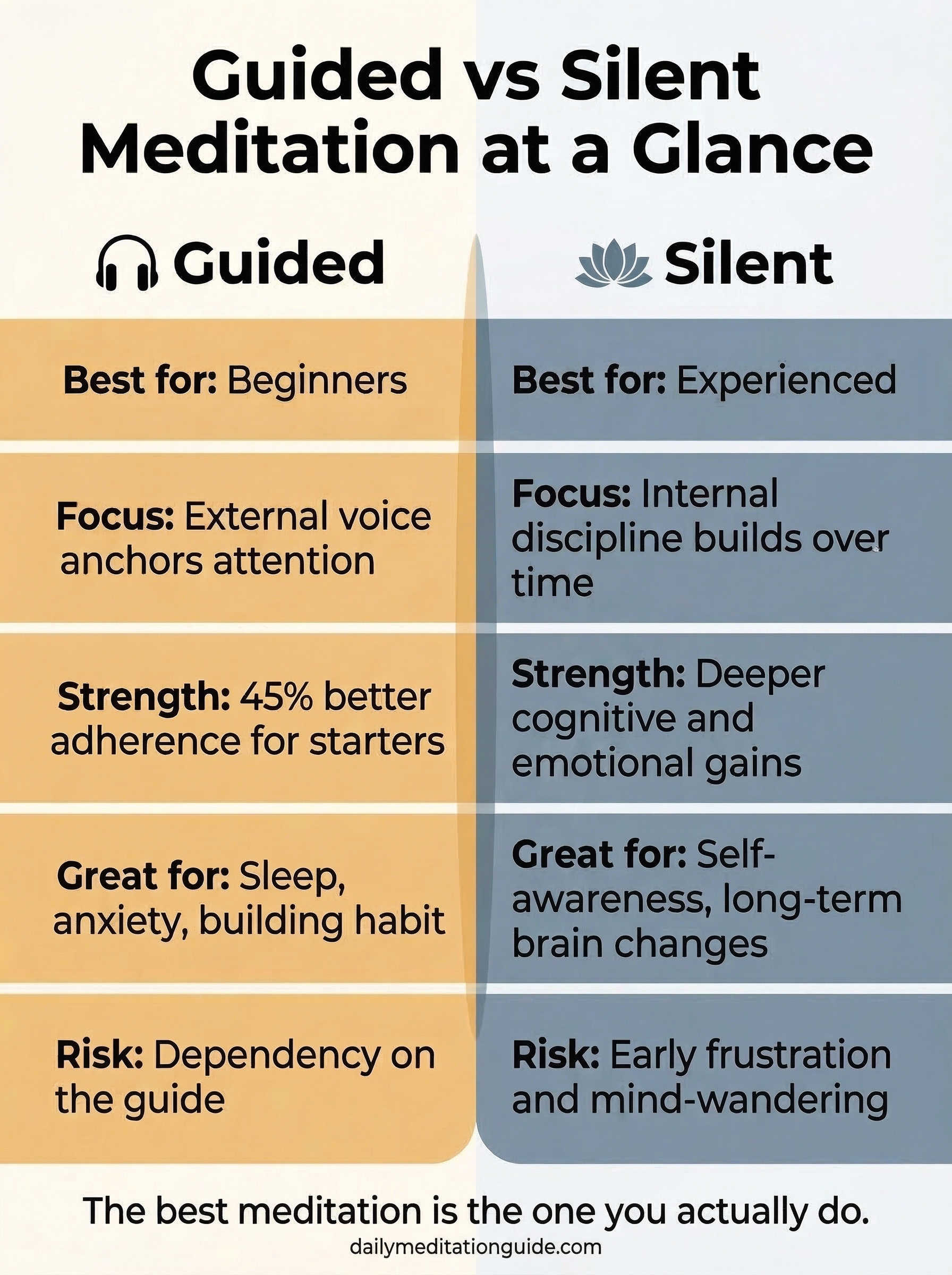
In one of the studies, beginners were assigned to guided meditation and were found to be 45% more likely to stick to the practice than beginners who immediately started silent practice. The mere fact that this number is so says something: meditation is best when it is done.
Guided Meditation: Where it Shines and Where it Falls Short
Guided sessions are perfect in the beginning, working with a particular problem (such as sleeping or anxiety), or a difficult period in your life when being alone with your thoughts seems like too much.
They also suit individuals with busy and distracted minds. And that, by the way, is nearly everybody. A voice telling you to get back to the here and now will save you the 20 minutes of being stuck in your own head without even knowing it.
The downside? The guide can make you dependent on him. I have also come across individuals who have been practicing meditation for years, but they are so lost as soon as they sit without an app. That is no failure. It only implies that they never trained the ability to focus on themselves.
The ceiling effect is also present. After some time, the same directed scripts begin to be monotonous. You have heard the scanner of the body a hundred times. You are familiar with the breathing guidelines. Once it does, then it is typically an indicator that you are prepared to take something a little less scaffolded.
Silent Meditation: Where it Shines and Where it Falls Short
Where the real depth lies, however, when we are speaking honestly, is in silent practice. In a world where no one is externalizing your experience, you must create that capacity on your own. And that ability within you carries to the rest of your life in a way that practice often within oneself does not.
Individuals who engage in regular silent meditation are likely to report increased concentration at work, increased emotional stability in challenging dialogues, and overall feelings of being less reactive. This is supported by the study on practitioners of Vipassana, whose neurophysiological effects are found in the brain regions of attention and self-regulation.
Yet the beginning stages are cruel. Without a guide, mind-wandering is immensely more acute. Frustration is common. And without the commentary, amateurs tend to think that they are wasting their time. There are those who attempt to do some silent meditation once, and in the process, they attempt it, and after 10 minutes, they feel uncomfortable and never return.
This is the reason behind the advice of most seasoned teachers to establish a base of guided practice, and then move on to the transition. You would not attempt to play jazz piano till you have mastered your scales. Same idea here!
How to Choose (Without Making it Complicated)
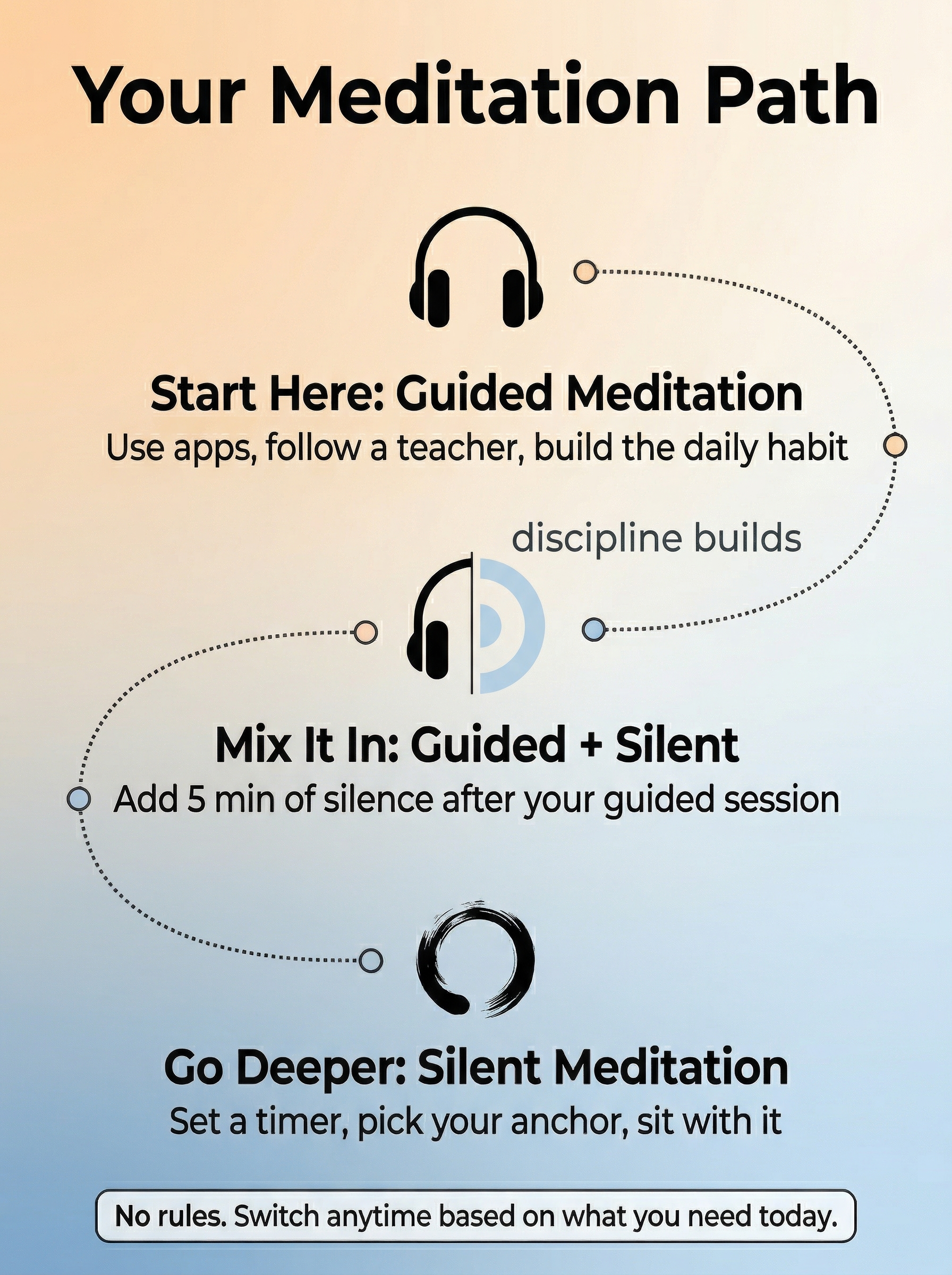
Unless you are new to meditation, begin with a guided tour. Apply for an application, take a course, or locate an instructor. There is nothing to worry about, and doing it the hard way. The objective is, at the moment, to develop a habit.
When you are a few months into your meditation practice, and the guided ones feel like a routine, begin adding some silent ones. Attempt five minutes of silence at the end of a guided session. See how it feels.
When you get used to the practice and desire to get deeper, lean in towards silent meditation. Set a timer, choose your anchor, and sit. The initial steps will be shaky. The practice is wobbliness.
And here is a point which people never talk of: you need not choose one forever. I continue to apply guided meditations on the days when my head is particularly chattering. During warmer days, I sit in quietness. It is not the law that you must choose to be devoted to one of the paths in life.
A Note on Consistency (Because it Matters More than Method)
The same thing is continuing to be discovered by researchers. The kind of meditation is not important as opposed to the frequency of its practice. The 10-minute guided session that you do daily will provide you with more benefits than the 45-minute silent sit that you complete once a month.
In case guided meditation continues to make you appear, that is the correct decision. In case the sole practice that is of interest to you is the silent meditation, then do that. The most terrible form of meditation is the one that is accumulating dust on your phone or that cushion that is accumulating cat hair in your corner.
So, Which One??
Guided meditation and silent meditation are not opposing methods. There are various tools for various situations. Begin where you are, listen to what works, and allow yourself to alter your strategy as you develop.
It is only possible to meditate with the wrong method, such as spending so much time researching the best method of doing it that you never actually sit down and meditate.
Yes. There are a good number of individuals who switch based on their moods, energy, or what they require during a particular day. Combinations of approaches do not have a downside.
The initial experience can be more difficult since it does not have an external structure. But being harder is not being better. They both need work, but in other forms.
Begin with five or ten minutes. It is sufficient to develop the habit and not to make it a chore. It is possible to add time later.
Not necessarily, but it will help. Even a teacher will be able to rectify the misconception and save you several months of frustration. Even several visits to a highly qualified practitioner are effective.
It has been proposed that guided meditation is more effective in anxiety reduction among beginner meditators. The extrinsic orientation offers your mind something to cling to rather than going mad. Silent meditation is also capable of helping as you grow, since you will develop the capacity to sit through the painful emotions without any response.