How To Manage High-Functioning Anxiety With Meditation

Sheenam Midha
Writer
April 17, 2026 · Updated April 17, 2026
You met your deadlines. You reply to emails at night. You are smiling in between meetings as your chest is as though a car was parked there. Nobody knows. That is what it is all about.
High-functioning anxiety does not appear as an issue to the outside world. It appears to be ambition. However, when you are on the inside, your brain won’t shut up, your body won’t unclench, and when you are told to “relax,” it feels like that person has never known you.
I will not tell you to relax. I will demonstrate to you how meditation for anxiety actually works, supported by factual studies, and built to suit those who can not sit still.
This guide discusses what is really working, why it is working, and how to make it fit in a life that is already considered too full.
What High-Functioning Anxiety Actually Feels Like
High-functioning anxiety is not a clinical diagnosis. It’s a pattern. Individuals who have it appear successful and feel wired, exhausted, and never satisfied.
The typical high-functioning anxiety symptoms are:
Racing thoughts you can’t switch off, especially at night
Overpreparing for everything, even small meetings
A constant low hum of dread you can’t trace to anything specific
Perfectionism that looks like ambition but feels like fear
Physical stuff: tight chest, tension headaches, waking up at 4 am
The bad part is that such characteristics usually land you in a higher position. It is driven according to your boss. Waiting to happen, your body calls it burnout.
Why Meditation For Anxiety Actually Works
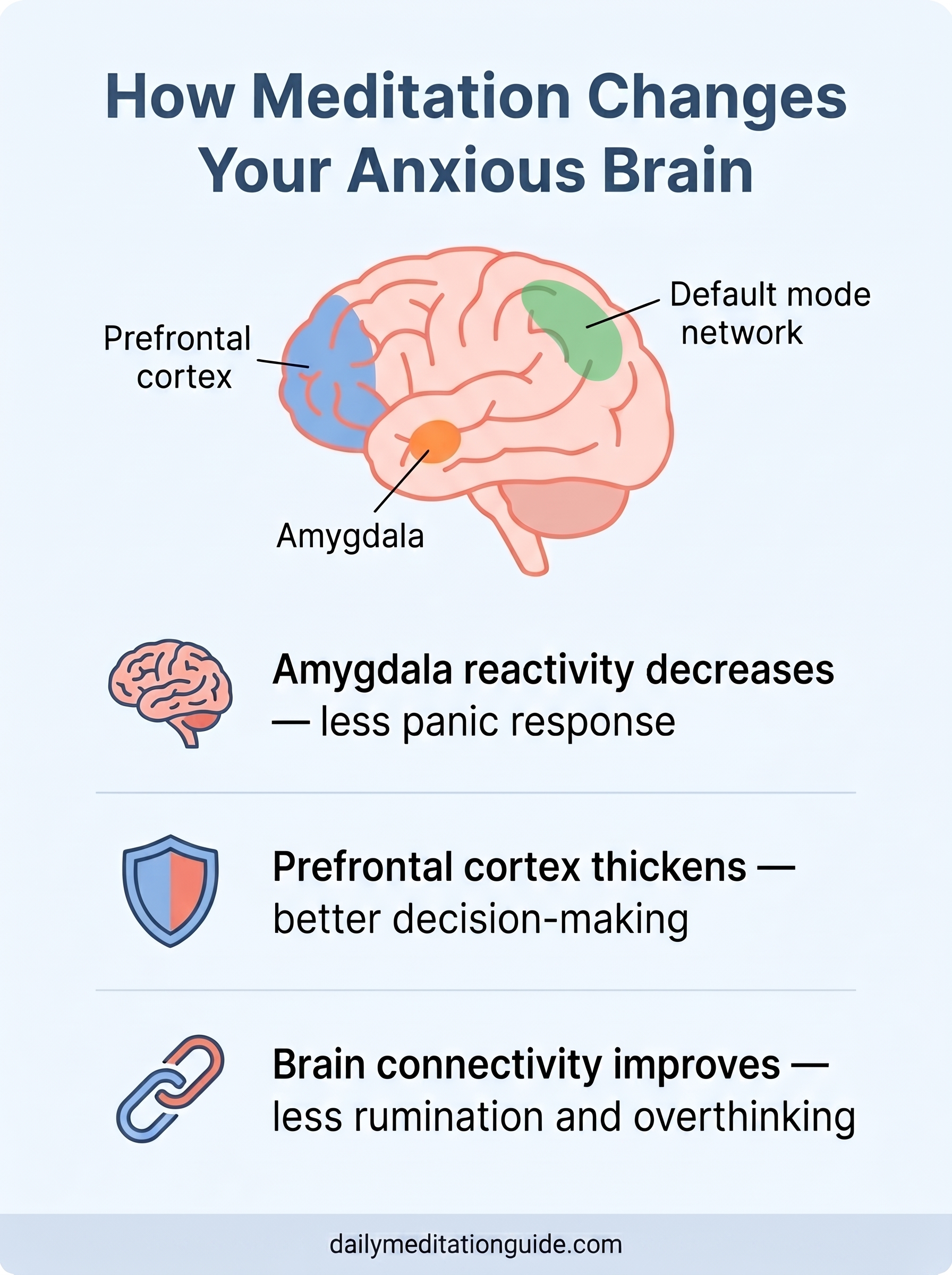
There is a small part of the brain, the amygdala. It’s the section that screams menace when you receive some unexpected Slack message while with your manager. This part is oversensitive and more responsive than it should be in individuals with chronic anxiety. The way it behaves is altered by meditation.
In JAMA Psychiatry, a 2022 randomized clinical trial compared 8 weeks of mindfulness-based stress reduction to one of the most prescribed anxiety medications, escitalopram. Mindfulness was equally effective as the drug, and without the side effects.
JAMA Internal Medicine published a meta-analysis of 47 trials with more than 3,500 participants that revealed moderate evidence indicating that mindfulness meditation decreases the state of anxiety, depression, and pain caused by stress.
Even 3 days of mindfulness training led to a reduction in stress-related amygdala connectivity in a randomized controlled trial (2015). Three days. Not three months.
A 2024 systematic review confirmed that regular practice decreases amygdala reactivity and enhances cortical thickness in emotion-regulation regions and strengthens the prefrontal cortex. In simple English: It is the planning part of you that becomes more powerful, and the panicking part of you becomes less vocal.
How To Start When Your Brain Won’t Sit Still
Meditation does not aim at having a blank mind. It is not being carried about by thoughts. Big difference.
The 5-minute warm-up program.
Set a timer for 5 minutes
Sit somewhere you won’t be interrupted
Breathe in for 4 counts, hold for 2, out for 6
When your mind wanders, notice it and come back to the breath
Don’t grade yourself
That’s it. Five minutes a day is better than 30 minutes once a week. Regularity is what is important, not time.
Four Meditation Techniques For High-Functioning Anxiety
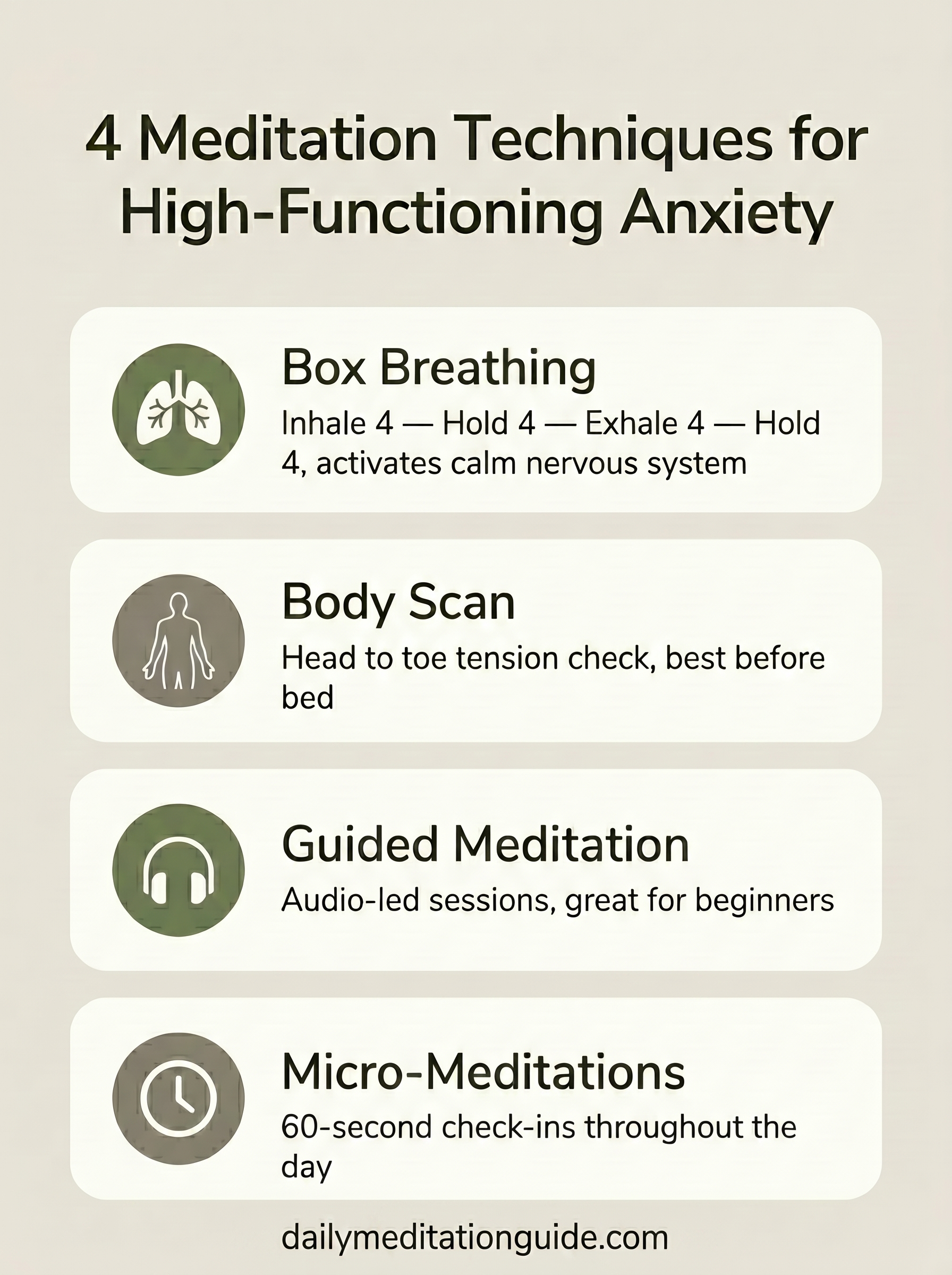
Box breathing
Breath 4x, pause 4x, breath 4x, pause 4x. Repeat for 2 minutes. It is among the most effective breathing exercises to use to overcome anxiety since it turns on your parasympathetic nervous system, the off-switch to fight-or-flight. This can be done during a meeting, and no one will be aware of it.
Body scan meditation
You make a mental journey through your body, head to toe, and you can see that there is tension, but you do not resolve it. Our anxiety is in the body even more than we acknowledge. Ideal just before sleep when you can’t relax because of your thoughts.
Guided meditation for anxiety
When it feels like a room full of your worst ideas to remain silent, guided meditation provides your brain with an outer voice to follow. There are free sessions in such apps as Insight Timer and Calm to reduce anxiety. Recommended for novices or when you just can’t sleep.
Micro-meditations
Check-ins of up to 60 seconds every day. Before meetings. As waiting to get coffee. Go ahead - close your eyes, breathe in three deep breaths, be aware of what is going on in your body. Move on. Studies indicate that multiple brief sessions would be as effective as a single, prolonged session, and among anxious overachievers, they would be more long-lasting.
How To Make It Stick
Pair it with something you already do. Before going to bed, meditate and brush your teeth. Breathe in a box, whilst the kettle boils. Habit stacking removes the “when will I find time?” problem.
Lower the bar. Do 3 in case 10 minutes is too many. One minute of practice that you do is better than a 20-minute practice that you miss.
Expect the backlash. Anxiety is sometimes more vocal when you begin to meditate, as you no longer have to distract yourself by doing this. That is the practice, not the practice that is not succeeding.
And in case your worries are becoming an obstacle to your life or relationships, then seek the services of a licensed therapist. Meditation does not substitute for professional assistance when you need it.
The Quiet Truth!
Anxious thoughts do not go away through meditation. It prevents them from running the show. You will always believe I will be fired due to this typo. You just won’t spend the next four hours living inside it.
That’s the actual win. Not a peaceful, empty mind. A noisy mind you’re no longer afraid of.
Begin with 5 minutes the next morning. In two weeks, see what will happen.
Yes. A JAMA Psychiatry study (2022) concluded that mindfulness meditation was effective when compared to escitalopram in treating anxiety disorders. With an average of 10-15 minutes per day of practice, results are expected to be shown in 4-8 weeks.
Guided meditation or anxiety body scan meditation. Both change the focus to the mental spiral. Guided audio is particularly desirable since it provides your brain with an object out of the box.
Begin with 5-10 minutes. The experimental procedures were based on 45-minute sessions, but it is not necessary to improve. Eight weeks, 10 minutes per day is better than 45 minutes twice and quit.
Yes. Both mindful walking and micro-meditations and guided sessions are effective for restless minds. When your head is in the clouds, that is the practice. Rep is to see the wander and to return.
Box breathing (4-4-4-4) and 4-7-8 breathing (inhale 4, hold 7, exhale 8). They both stimulate the parasympathetic nervous system between 60 seconds and 90 seconds. The active ingredient is the long exhale - it directly decreases your heart rate.