The Connection Between Meditation And Heart Health

Sheenam Midha
Writer
April 23, 2026 · Updated April 23, 2026
Heart disease is the cause of death of more Americans than any other. We are all aware that this is a fact, but few of us sit down. We hear, shake our heads, and go back to whatever we were doing. But here we have something to pause and ponder over: what about the fact that only sitting and spending 10-15 minutes of your day can be good for your heart?
This is what an increasing body of research tells us about meditation. Not a magic treatment. Not to take the place of your medicines or your daily walk. But since it is a surprisingly useful add-on, which your cardiologist probably wouldn’t argue with.
We will explore the real evidence and why meditation's health benefits are far more than feeling relaxed.
What happens to your heart when you meditate
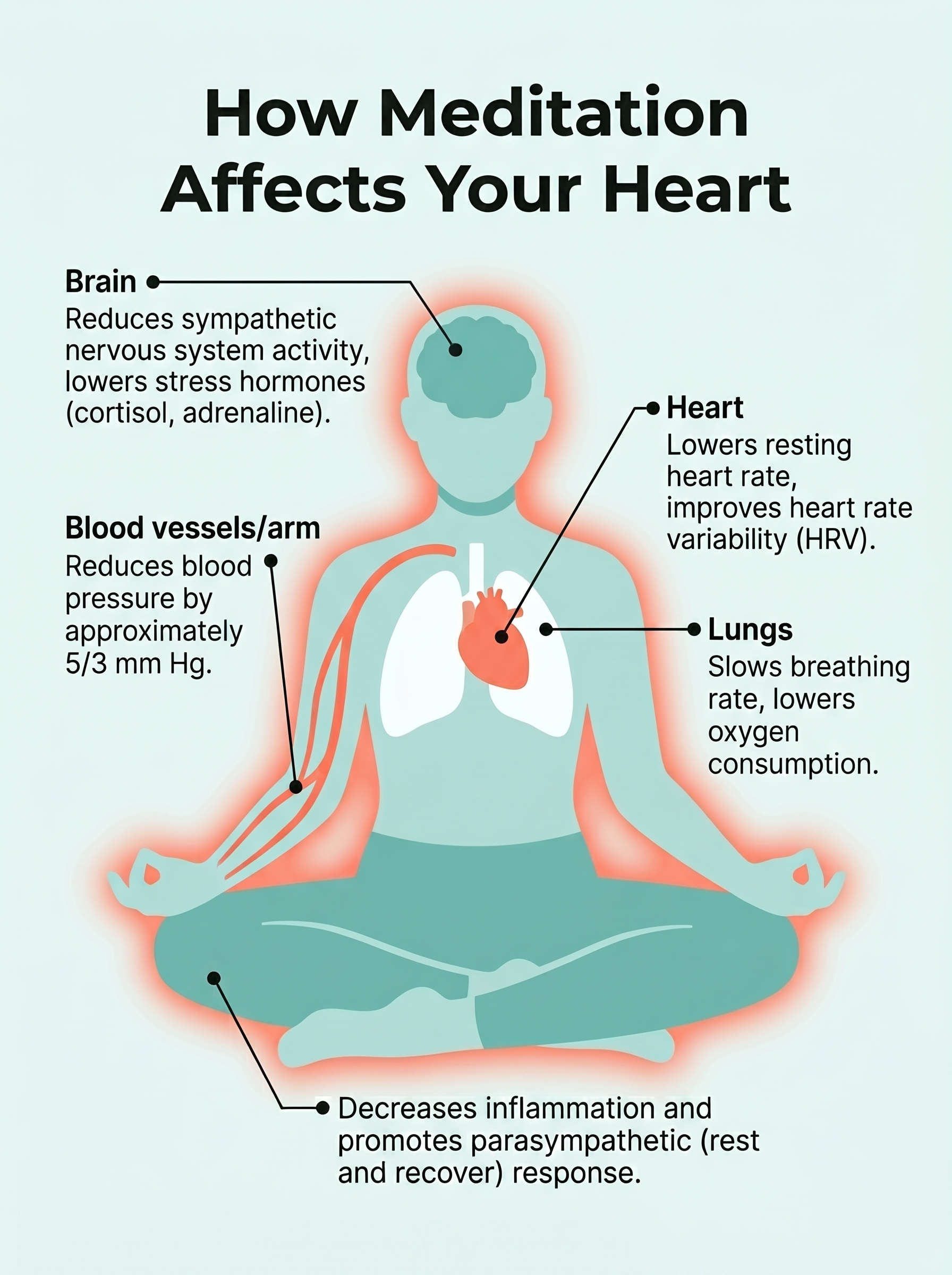
It is interesting what your body does when you are sitting down to meditate. Your breathing slows. Your heartbeat slows. Your blood pressure drops some notches. These are not some kind of good vibes. These are quantifiable variations which scientists have long been monitoring.
A review published in the Texas Heart Institute Journal has identified that meditation lowers a few cardiovascular risk factors, such as high blood pressure, type 2 diabetes, high cortisol levels, and high cholesterol. The review also mentioned that meditation will reduce depression and anxiety, which is associated with poorer prognoses among heart patients.
Biologically, meditation reduces the activity of your sympathetic nervous system. Traffic jams, workplace stress, a 24/7 news cycle, and all the time it is firing are wearing down your blood vessels and raising your blood pressure in the long run. Meditation dials the response in reverse and lets the rest-and-recover side (parasympathetic system) take over a little.
Stress reduction and cardiovascular disease
Chronic stress is one of the more sinister risk factors of heart problems. It does not show up on a blood test as cholesterol does, but it triggers habits (poor sleep, overeating, smoking) and physiological mechanisms (inflammation, high cortisol) that damage your cardiovascular system in the long term.
According to the American Heart Association, stress can be dealt with through mindfulness and meditation, which help to sleep better and decrease the probability of heart disease occurrence. They are also very careful in their words to state that meditation does not substitute other lifestyle modifications; it can be employed together with them. It is noteworthy, however, that it is even mentioned by the AHA.
Blood pressure and meditation
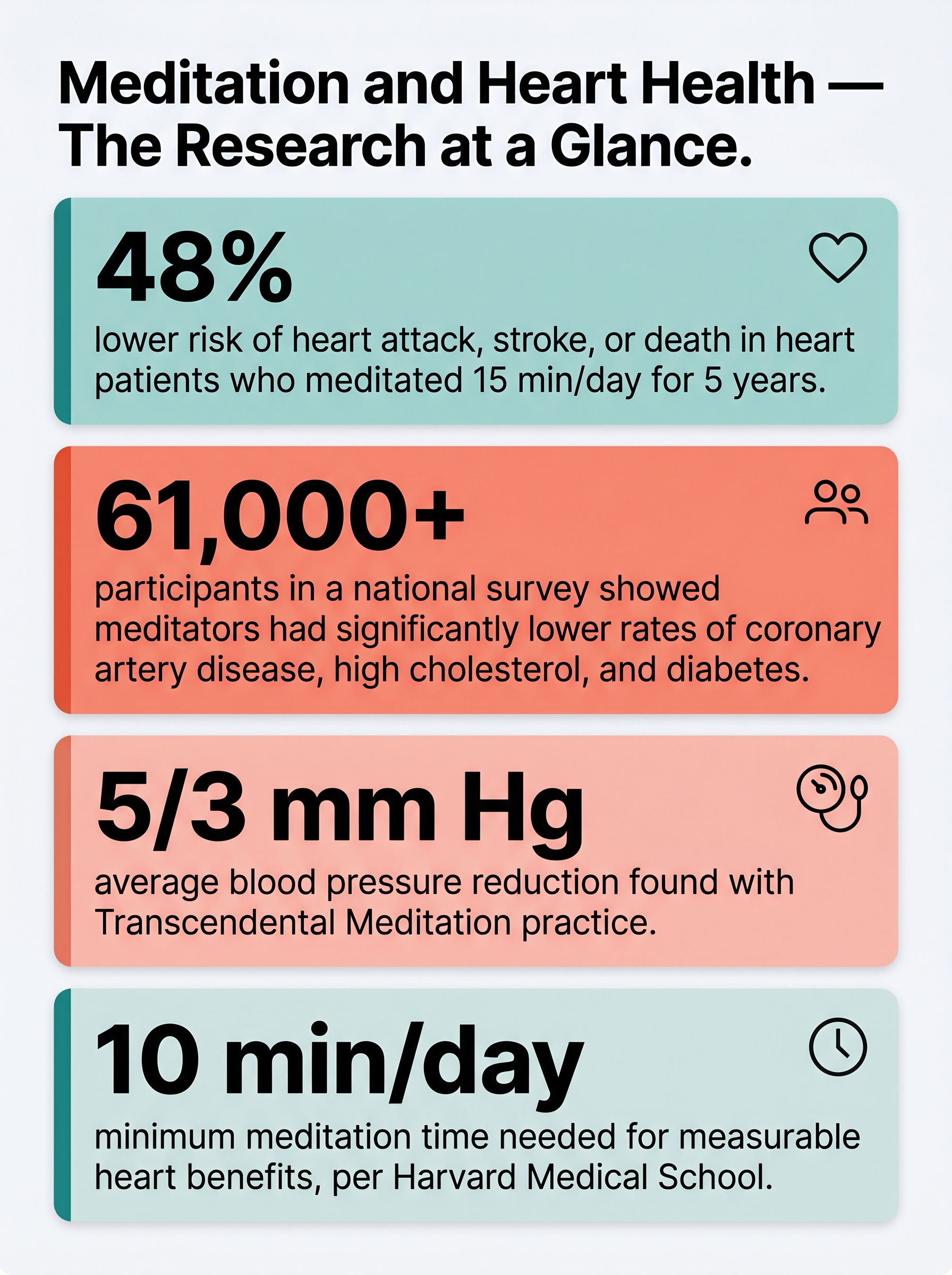
Some of the strongest evidence is where blood pressure is concerned. The existing data were reviewed in a scientific statement by the American Heart Association, which found that Transcendental Meditation slightly decreases blood pressure. A systematic review they referred to concluded in a reduction of about 5/3 mm Hg (systolic/diastolic), a difference that might not seem much until you consider that any small changes in the blood pressure decrease the chances of a stroke and heart attack.
Other forms of meditation are not investigated in serious trials, but the trend of the evidence is the same: to relax your mind, you are also likely to relax your blood vessels.
The 48% study that caught everyone’s attention
A single study continues to appear in nearly every article on heart-related studies on meditation, for a reason. The researchers tracked 201 patients with coronary heart disease, and half of them were requested to practice Transcendental Meditation for about 15 minutes a day. A 48 percent reduction in risk of heart attack, stroke, or death was observed in the meditation group after five years in comparison to the control group. The decreases were associated with decreased blood pressure and reduced stress.
A large amount. It is also interesting to note that these were not young people of 25 years, but people with pre-existing heart disease. As such, the gains were manifested in a population in dire need.
The results were reported by Harvard Health and cited by cardiologist Dr. Deepak Bhatt, who teaches at Harvard Medical School, who recommends meditation as an additional measure to prevent cardiovascular risk, in addition to diet and exercise. He noted that meditation appears to slow down the heart rate, blood pressure, respiration rate, oxygen uptake, stress hormone rates of adrenaline and cortisol.
Heart rate variability: why it matters
You may not be concerned with your heart rate variability (HRV), but physicians are. The HRV is a measure of the adaptability of your heart to rest and exercise. Increased HRV is an indicator of a more flexible and stronger heart. The decreased HRV is connected to the increased risk of cardiovascular events.
Meditation has also been found to enhance HRV, or in other words, the more your heart becomes adapted to meet the changing needs of everyday life. Imagine that you are working on getting your heart more flexible, rather than stronger.
How to actually start (without overthinking it)
The idea might seem overwhelming to you as a beginner meditator. It should not have to be a complicated matter, though. It may be relaxed in the following ways:
Find a place to sit, close your eyes, and focus on your breathing for five minutes. When you happen to think (which you will), concentrate your thoughts silently.
Do a guided meditation with an app. A few minutes, 5 or 10, will suffice to start with.
Be mindful in daily activities like walking, eating, or washing the dishes. Be aware of your feelings and not your thoughts.
Do yoga in case sitting still is not possible. It is a combination of movement, breathwork, and meditation, and it has its evidence base to support benefits to the heart.
The graduality of things is more important than time. One hour a day is better than an hour a month.
Meditation and heart disease prevention: the bigger picture
Meditation is not a treatment in itself. No good cardiologist would advise you to leave your statins at home and go out and take a deep breath. However, the statistics indicate that with meditation added to an already existing treatment regime, things are likely to get better.
One of the studies conducted by VA Research to examine more than 61,000 participants is a large study based on the National Health Interview Survey data. The meditators experienced lower cholesterol, lower blood pressure, lower diabetes, lower stroke, and lower coronary artery disease. The largest difference was in the coronary artery disease: meditators had about half the likelihood of having it.
Correlation is not causation, now. There is a possibility that the healthier individuals are simply more prone to meditate. However, when you put this together with the controlled trials that were able to demonstrate the direct physiological changes, the image begins to look very convincing.
It is possible, according to research. A five-year follow-up of patients who already had heart disease revealed that meditation practice akin to regular practice was linked to a reduced risk of heart attack, stroke, or death by 48%. Heart disease meditation is a potentially useful tool to add to the medical treatment and lifestyle modifications aimed at decreasing the occurrence of heart disease.
Most of the trials that showed an effect on cardiovascular benefit employed 10-15-minute daily sessions. Harvard Medical School suggests that a minimum of 10 minutes a day will be necessary to see some physiological changes, including a decrease in blood pressure and stress hormones. You may begin with five minutes and go up progressively.
There is some justifiable evidence, all right. The American Heart Association has gone through the study and has concluded that there is a small effect of Transcendental Meditation in lowering blood pressure, with some of the studies showing a lowering of about 5/3 mm Hg. Other mindfulness meditations are moving along the same way, but have not undergone the same level of research in the form of clinical trials.
Among the clinical ones, Transcendental Meditation has been the most studied, and thus the reason it is specifically mentioned by the American Heart Association. Nonetheless, mindfulness meditation, guided meditation, and yoga-based practices have been found to be helpful with stress and heart health. The best type is the one you do regularly.
No. Meditation is not a replacement for medical treatment; it is a supplement. This point is evident in both the American Heart Association and Harvard Medical School. Do not stop taking the medication given by your doctor to control blood pressure, cholesterol, or any other condition of the heart. Meditation is not a replacement for your treatment plan, but may rather complement it.
Related Sessions
7 Signs You’re Actually Meditating Correctly
· Focus
Mindfulness vs. Transcendental Meditation: Finding Your Perfect Practice
· Focus
How to Meditate at Work Without Anyone Noticing
· Focus
Guided Vs Silent Meditation: Which One Actually Works For You?
· Focus
Morning vs. Night: When is the Best Time to Meditate?
· Sleep
How To Manage High-Functioning Anxiety With Meditation
· Anxiety
5 Common Meditation Myths That Hold You Back
· Anxiety
The Science of Breathing: How Pranayama Changes the Brain
· Anxiety
10 Mindfulness Exercises for Busy Professionals
· Sleep
Related
7 Signs You’re Actually Meditating Correctly
Mindfulness vs. Transcendental Meditation: Finding Your Perfect Practice
How to Meditate at Work Without Anyone Noticing
Guided Vs Silent Meditation: Which One Actually Works For You?
Morning vs. Night: When is the Best Time to Meditate?
How To Manage High-Functioning Anxiety With Meditation
5 Common Meditation Myths That Hold You Back
The Science of Breathing: How Pranayama Changes the Brain
10 Mindfulness Exercises for Busy Professionals